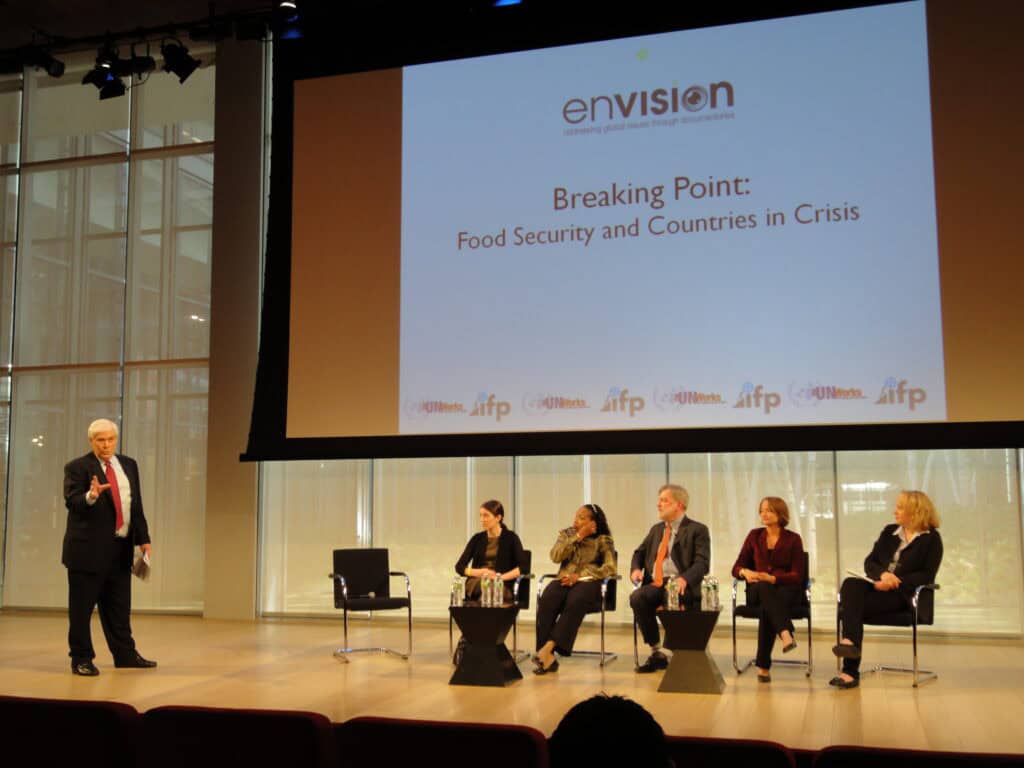
Proposed U.S. budget cuts could deepen global hunger, as nearly one billion people already struggle to access enough food worldwide, aid agencies have warned at the Envision forum in New York.
PLAY AUDIO:
Audio Script:
International aid agencies warn global food insecurity could worsen following $38 billion in U.S. federal budget cuts.
There are concerns American food security and food aid programs could be reduced by up to a third, prompting UN agencies and NGOs to meet in New York at the Envision forum to discuss poverty solutions and the need to support agriculture worldwide.
Nicky Redl reports from New York.
NICKY REDL: Nearly one billion people globally don’t have enough to eat – 98 percent of those live in developing countries. And most live in rural areas. Bettina Luescher from the UN’s World Food Program says, despite the efforts of aid agencies, the number of people suffering hunger has actually increased due to rising food prices, conflict, and droughts or floods. And that is going to affect developed nations.
BETTINA LUESCHER: What I always say is that a hungry man is an angry man, that old saying. And it is so true. If you look here at the situation in the U.S. for example, how many people immigrate from other countries, from Central and Latin America, because they see a chance here in the US, because they want to make a living. That’s what everybody just wants – people want to make a living, they want to feed their families.
NICKY REDL: In Australia, foreign aid is set to increase, but still, at the moment, it is no more than 1.2 percent of the federal budget. Australia sits on an unglamorous 16th place out of 23 OECD donor countries. In the US, it’s worse. Proposed federal budget cuts mean that its funding for aid projects will most likely decrease significantly. And that, even though less than 1 percent of the U.S. federal budget goes into foreign aid.
To Remi Cole, director of agriculture and food security at Africare, and aid organization working in Sub-Saharan Africa, those budget cuts are deeply worrisome.
REMI COLE: The programs we implement are very successful, because we go to the very remote areas of Africa where TV and cameras and development people are not going to, and we make a big difference in whatever we do. The thing that gets in the way of our work is funding. Our largest funder is USAID. And given the budget cuts right now, we are very, very skeptical, we are really at a bind how to continue our programs and to ensure that people sustainably become food secure… (continues)
Broadcast on ABC Radio National on April 12, 2011.