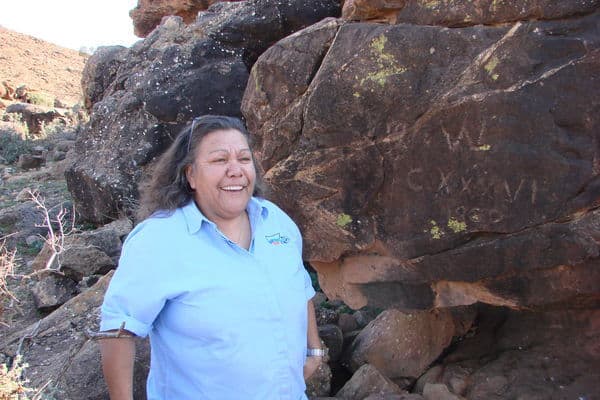
At Kukirrka, or Burkes Cave near Menindee, Barkindji woman Dot Stephens explains the site’s deep cultural significance as an Aboriginal women’s birthing place used for thousands of years, as well as its later links to the Burke and Wills trail and Cobb & Co routes. Traditional rock stencils and engravings remain inside the cave, but efforts are now underway to protect the sacred site from rain damage and feral goats.
PLAY AUDIO:
Audio Script:
(sound of footsteps on trail)
DOT STEPHENS: Can you smell the lemongrass? Can you smell the lemongrass? Hi, my name is Doctor Stevens. I’m a Barkindji person from Menindee area, and I work for the Western Catchment Management Authority as the Aboriginal Community Support Officer.
NICKY REDL: And what’s happening here today? We’re standing in front of this cave here.
DOT STEPHENS: This is called the Burkes Cave. It’s the birthing place for Aboriginal women that came through this area to give birth in the Western Catchment area, and it’s part of the Barkindji culture and heritage.
NICKY REDL: Can you explain to me a bit all the different parts of the cave? We’re walking in here now. There are a few writings there on the wall. Where is that coming from?
DOT STEPHENS: This was not also a second stopover for the Aboriginal women that gave birth in this area. It’s actually got its name because it’s part of Burke and Wills trail. And it’s also the second stopover for the Cobb and Co. And when people came through and stopped here, we’ve got some of the engravings that’s actually scratched into the rocks. It’s where the early explorers and people came through here on horse and cart on Cobb and Co, and some of them date back to 1886, 1910, 1887. And so it goes right back into the 1800s.
NICKY REDL: So, is that original, for example, what we’re seeing here? It says, K. Wilson 1888.
DOT STEPHENS: How it looks, that’s really one of the old carvings in 1888 that was done by Mr. K Wilson. I couldn’t tell you who he is, but he would have been one of the first early settlers that came through this way.
NICKY REDL: What was this back part of the cave for?
DOT STEPHENS: This back part of the cave is where the women gave birth. And after the baby was born, the baby was actually washed in a basin back up top up there. It’s back in further in the cave where they had a little bit of water to wash the babies.
NICKY REDL: The place is tiny up there.
DOT STEPHENS: It’s very tiny. But Aboriginal women weren’t very tall, rather, we were all very short.
NICKY REDL: How many women do you think would be in here together?
DOT STEPHENS: Oh, about half a dozen, 3 or 4.
NICKY REDL: The pregnant ones, did they travel together out here and then camp in the area and wait to give birth?
DOT STEPHENS: Yeah, they’d come this way through here before it was their time to have their babies, and then the men and women would camp here.
NICKY REDL: How far would they normally travel?
DOT STEPHENS: From where the stayed, where they originally lived in Menindee, along the river, to walk out here would be about 70 or 80 kilometers.
NICKY REDL: And why did they pick this particular cave?
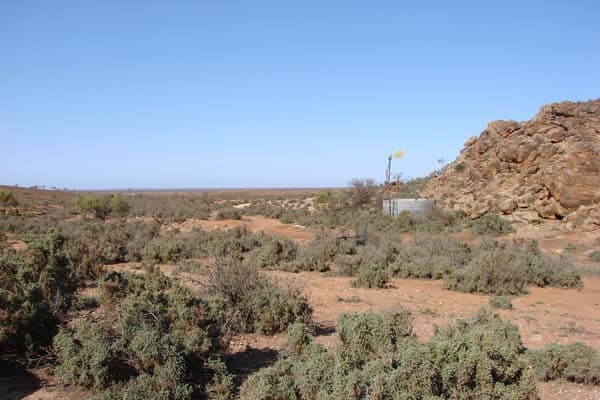
DOT STEPHENS: Because if we just go back up from Burke and Wills cave, there was a water hole. So, it was permanent water; plus it had a lot of food here as well.
NICKY REDL: Can we just walk up there now just to have a look at the men’s side? (sound foot steps on trail) So, they were quite a bit further up there. Why were they so far away, the men?
DOT STEPHENS: Because the men were never around where ladies gave birth. Not like nowadays, where the men can go into the delivery rooms. But, the men always sat away from the women when the women gave birth. Then the women went up and got the men, and they were introduced to their to their offspring then.
NICKY REDL: There are quite a few paintings in there. What do they mean?
DOT STEPHENS: I have actually never been in there for my own personal reasons. I won’t go into a men’s site, but I’ve heard that there are small babies stencils in there, adult stencils, and animal tracks. When the men get there and were first introduced to their their baby, their child, they’d bring them back and they’d stencil their hands in the rocks.
NICKY REDL: And how are they made?
DOT STEPHENS: It’s an ochre. When you grind it up on a rock, with a round rock, flat rock and round rock. You grind it down, it makes a powder. And with that powder, they’d use their own saliva to make it into a paste. And then they put it into their mouth and they put their hands or whatever stencils they want to do, and they spray it from their mouth onto their hands, on the handprint. And that’s how the stencils were made.
NICKY REDL: How many men would normally wait in there?
DOT STEPHENS:: It could be one man with his four wives or six wives, or it could be the whole tribe group that came here, and a couple of women in the group would be pregnant, and they’d all wait till they had their babies, and then they’d all move on.
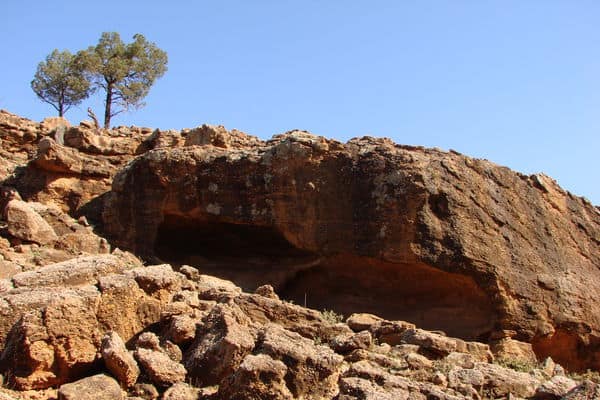
NICKY REDL: But these days, the site is mostly inhabited by feral goats, and those aren’t showing much respect for the old paintings and engravings and stencil works. And rainwater has also done some harm. Dot Stephens again.
DOT STEPHENS: What we’re looking at doing is at the Burke and Wills site, which is the second stop over for the Cobb and Co, plus the Aboriginal women’s birthing site, we’re looking at laying down some gridlock mesh and putting a drip line on top part of the rock face. So, when it rains, it keeps the water out of the stencil work that’s in there, because it’s really, really old. And to protect it from the water, to stop it from washing off. And the gridlock mesh that we’re laying in front of it and in the cave a bit is to keep the feral goats out.
But it’s got a really nice advantages in this creek bed where we’re walking to now. We have little stubbles of grass and it’s lemongrass when the goats don’t eat it. And you come out here in a nice time, and especially when it’s blowing a bit of wind, the lemongrass is absolutely beautiful.
Broadcast on the ABC Country Hour in September, 2009. In 2025, the NSW government acquired the 31,500-hectare Broughton Vale Station, which includes Kukirrka, or Burkes Cave, for permanent protection.